
Typing While White
I didn’t choose the anti-establishment life. The anti-establishment life chose me.

Last week, a young author named Jordan Lee ran afoul of the cancel mob. Her crime? She wrote an introspective tweet exploring the reasons literary agents may have rejected her novel.
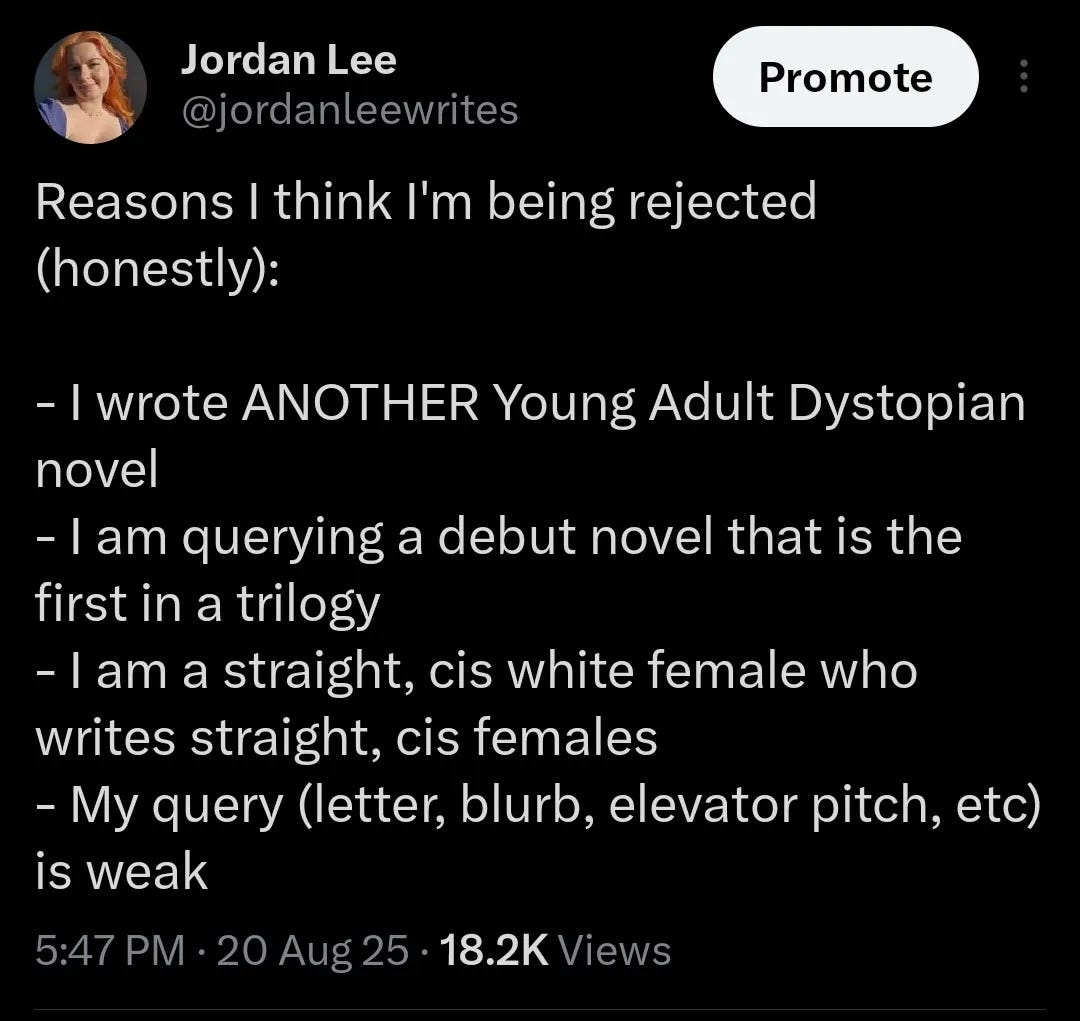
Ms. Lee described the events in her own words, but here’s a summary:
Straight, white author writes cisgender characters in straight relationships. (She informed me she does not write exclusively white characters.)
Author notices that many literary agents openly seek LGBTQ and BIPOC characters.
Author publicly wonders if her novel is poorly timed — in part because of genre, in part because of her race and her characters’ sexual orientation.
Wokescolds go ballistic; vicious dogpile ensues.
Contrary to the mob’s accusations, Ms. Lee never called herself a victim of the publishing industry. She never pitied herself. She simply speculated about the effect of market forces on her book, and she correctly noted that many literary agents seek submissions involving specific demographics. Agent listings like these are commonplace:
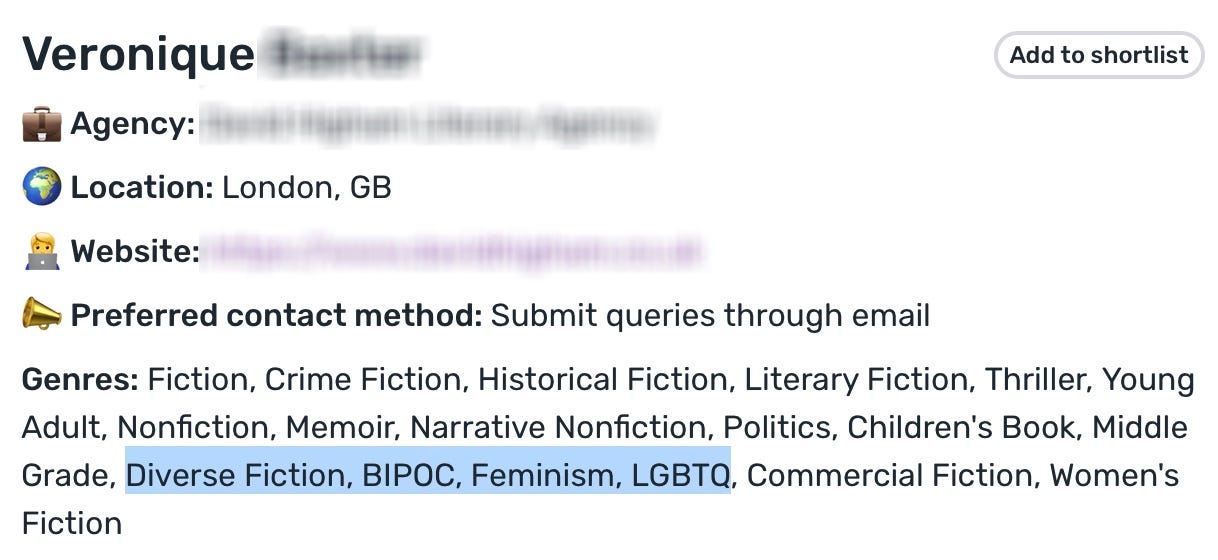
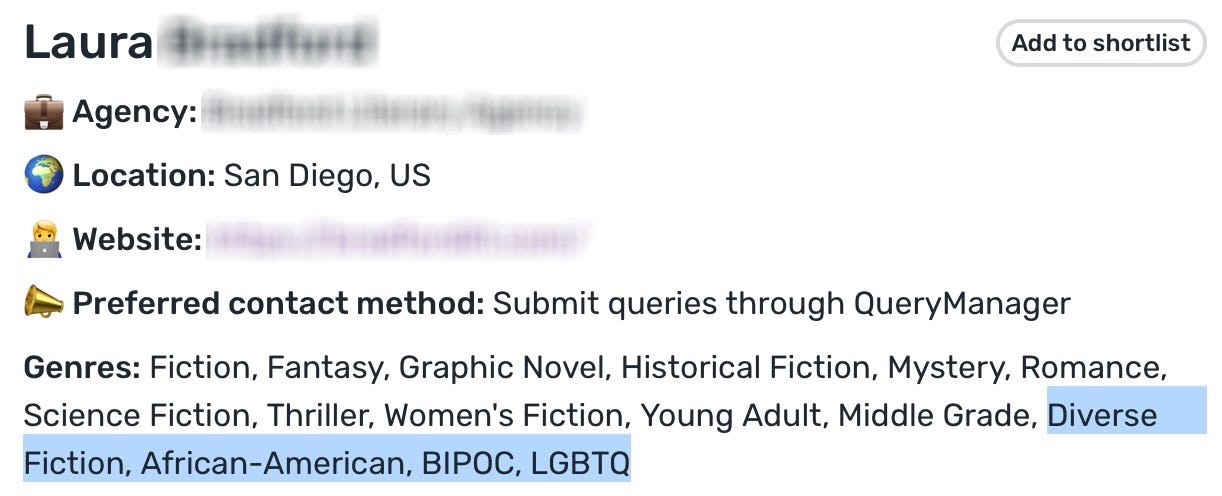
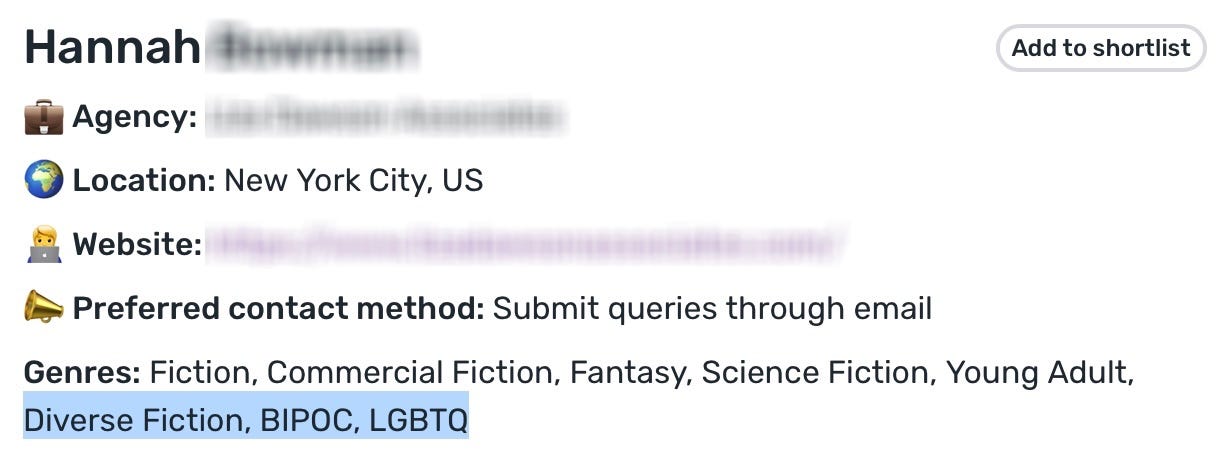
It’s only reasonable to conclude that an agent’s demographic preferences extend to the authors she signs. I assume diverse fiction (whatever that is) must be written by diverse people in order to avoid charges of cultural appropriation. Such an accusation would undoubtedly involve the same abuse and cancellation Jordan Lee endured.
Maybe you think it’s racist or sexist to prioritize an author’s immutable characteristics over the quality of their work. Or maybe you think it’s about damn time someone evened the score. I have my opinions, but my opinions are boring. I’d rather talk about the business of publishing.
Literary agents (the overwhelming majority of whom are young, straight, white women) are the gatekeepers to the publishing establishment. Ms. Lee pissed ‘em off, and it’s possible she is now blackballed.
(I saw a similar banishment occur in junior high after Becky Vasquez showed up to school wearing a retainer. The cool girls wouldn’t let her eat lunch at their table anymore.)
It appears Ms. Lee is now an outsider to the publishing establishment, at least for the moment. That doesn’t mean she’s anti-establishment… but she could be, if she wanted.
To be anti-establishment in business (I’m not talking about societies) is to serve an audience that feels alienated and poorly represented by the prevailing order. I discovered this by accident, being a psychologist who has had a somewhat anti-establishment career. Here are a few highlights, if you can call them that:
In 2007, when I was a newly minted shrink, a group of social psychologists published a widely publicized paper claiming political conservatives were intolerant and dimwitted. The paper was a political diatribe masquerading as research, and it dehumanized decent people. I didn’t like that, so I wrote a critique of the study’s indefensible methodology. I didn’t write the rebuttal to market my business, but to my surprise it put my fledgling clinical practice on the map. Suddenly, I was blessed with an abundance of wonderful clients who long felt alienated by my reliably left-leaning profession.
In 2017, I wrote a book called “The Tactical Guide to Women.” It sounds misogynistic, but it’s really just a relationship book that takes men’s needs into account, and not at the expense of women. The book is anti-establishment only in the sense that my profession generally defers to the interests of women, sometimes at the expense of men. The book continues to find a wide audience of men who feel my profession is generally unconcerned with their wellbeing.
In 2018, I loudly criticized the American Psychological Association for their ideologically driven Guidelines for Psychological Practice with Boys and Men. Once again, I saw my profession maligning decent people for political points, so I responded with videos like this one. A psychologist can’t get any more anti-establishment. The APA is the establishment.
I never took an anti-establishment stance as a marketing ploy. I tried to stand on principle and avoid saying anything unkind, untrue, or unreasonable. Nevertheless, going against the grain put me in touch with a large, disenfranchised audience.
Jordan Lee also said nothing unkind, untrue, or unreasonable. As far as I can tell, she simply repeated what so many literary agents openly advertise: We’re not very interested in straight, white people. That’s unfortunate for Ms. Lee, but maybe she can find some encouragement in my experience and ambitions. As it happens, my debut novel will drop next year, and it’s everything establishment publishers are not seeking in literary fiction at the moment:
A protagonist who is working-class and unapologetically male
A love interest who is a normal human, not an invincible boss bitch
The absence of political messaging or morality lectures
A story that appeals to men
An author who is straight, white, and male
Among the Vassar grads who rule traditional publishing, my novel will be about as welcome as gonorrhea. That’s not a problem for me. I have no intention of offering my book to a traditional publisher. The reasons have nothing to do with establishment ideology. It’s just business.
In fact, I hope to profit by the over-politicized atmosphere. I believe the current gatekeepers are maintaining a gap in the marketplace that my book will fill quite nicely. To whatever extent I can honestly position my book as an anti-establishment product, I will do so. (But that’s not why I’m writing it.)
As for the literary agents in question, Ms. Lee may be better off without them. That’s her call, but I can’t imagine why any serious author would hire a blue-haired goofball who is more committed to the culture war than to the business of publishing.
I’m not offering advice to Ms. Lee. It’s not my place. I won’t say to her, “Congratulations! The twits who run the show have positioned your novel to be ‘the book they didn’t want you to read.’”
I won’t say that because unsolicited advice is obnoxious, and because what works for me might blow up in her face. Instead, I’ll speak for myself:
When I release my novel next year, I pray the wokescolds will cancel it.
I wonder if cisgenders aren’t qualified to create valid entertainment unless they profess, no evidence required by the looks of it, to write with a lgbt perspective—is the reverse true…can non-cisgender critics be qualified to judge cisgender entertainment and content? I’m asking for a few hundred million friends. Based the equitable application of their own requirements, it is a hard no. They can ruin publishing like they did film and drive up demand for stalwart creators who capture real universal stories for a market starving for entertainment without the moral signaling. Write what you know! If it’s from the heart another heart will feel it even if the main character prefers Chevy over Ford and The Rolling Stones over the Beatles.
Highly anticipating your novel.
You won't need to pay a PR company, the Post Modernist, moral exemplars & schoolmarms will work tirelessly to create awareness. This is 21st Century organic advertising at its best.